
How to Read Paul's Letters
Approaching Paul
Approaching Paul is not quite as easy as it seems. If you are familiar at all with the current studies of his life and mission/ministry, you will quickly become aware that after almost 2000 years deciphering what he had to say has not exhausted the pens of New Testament scholars or historians.
What then are some of the reasons for the difficulties that emerge when approaching Paul?
Paul is a man engaged in ministry and rarely has time to be the “cool and remote theologian.”
“At times, Saul reminds one of a vice-principal of a large urban high school who has to teach a daily class in calculus to the college-bound stream, then, as head of discipline he breaks up a fight in the hall, and next he finds he has to fill in for a shop teacher who has gone home with a migraine. After school he coaches the offensive line of the football team, and finally at night he has to appear before a special session of the city council and give a polished argument for continued funding of the art and music classes. So we honor the canon of Saul’s letters by accepting their sometimes-distracted, sometimes-staccato quality as part of the warrant of their authenticity, the words of a man on a mission.” Akenson, Saint Paul, p. 134.
1. Paul gives us only a piecemeal picture of his theological positions.
Paul gives us only a piecemeal picture of his theological positions.Apart from Romans, Paul’s letters were written to congregations who knew him and who had heard him preach; they tend to fill in the gaps in their understanding of the gospel rather than start from the beginning. Often Paul is concentrating on points which have been misunderstood and mistakes which need to be put right. 2.Everything Paul wrote was occasional literature.
Everything Paul wrote was occasional literature. a.It is the problem of knowing the extent to which the particular situation in which Paul found himself, and the particular situation of the community to which he was writing, have influenced not only what he chose to say, but the way in which he said it. Example: We would not know the Pauline tradition of the Last Supper if the Corinthians’ behavior at the Eucharist had not seemed to Paul to be scandalous.
It is the problem of knowing the extent to which the particular situation in which Paul found himself, and the particular situation of the community to which he was writing, have influenced not only what he chose to say, but the way in which he said it. Example: We would not know the Pauline tradition of the Last Supper if the Corinthians’ behavior at the Eucharist had not seemed to Paul to be scandalous.b.It is also the problem of knowing to what extent Paul’s own experiences and problems have influenced what he writes. “Paul’s theology was no more static than Paul himself, and in reading his letters we are reading theology in the making. If we try to make them into a systematic structure, we may well distort his teaching; Paul is essentially a practical theologian.” Hooker, p.10
It is also the problem of knowing to what extent Paul’s own experiences and problems have influenced what he writes. “Paul’s theology was no more static than Paul himself, and in reading his letters we are reading theology in the making. If we try to make them into a systematic structure, we may well distort his teaching; Paul is essentially a practical theologian.” Hooker, p.103.We know so little about the opposition he was addressing and the alternative interpretations of the gospel being put forth that he sought to correct. What he has to say was often shaped by those he was addressing. Knowing the opposing situation would give us valuable insights in understanding Paul’s responses.
We know so little about the opposition he was addressing and the alternative interpretations of the gospel being put forth that he sought to correct. What he has to say was often shaped by those he was addressing. Knowing the opposing situation would give us valuable insights in understanding Paul’s responses.4.We often misread Paul because we are doing so from the context of Christianity. We fail to remember that most—if not all—of the New Testament was written from within the context of Judaism. We tend to think in terms of Jews and Christians which would be foreign to Paul. For him the natural antithesis was Jew and Gentile. For Paul, Christian was the true fulfillment of Judaism, which paradoxically embraced Gentiles. Therefore, the, “we need to remember Paul’s Jewish background and assumptions; those interpreters who have made him into a Hellenistic thinker have perhaps forgotten the part of Paul’s theology which he did not need to stress.”
We often misread Paul because we are doing so from the context of Christianity. We fail to remember that most—if not all—of the New Testament was written from within the context of Judaism. We tend to think in terms of Jews and Christians which would be foreign to Paul. For him the natural antithesis was Jew and Gentile. For Paul, Christian was the true fulfillment of Judaism, which paradoxically embraced Gentiles. Therefore, the, “we need to remember Paul’s Jewish background and assumptions; those interpreters who have made him into a Hellenistic thinker have perhaps forgotten the part of Paul’s theology which he did not need to stress.” 5.We distort Paul if we forget that his terms and forms and expressions were inherited from his culture and background. “Some New Testament terms quickly lost their meaning when Christianity moved out of its Jewish context.
We distort Paul if we forget that his terms and forms and expressions were inherited from his culture and background. “Some New Testament terms quickly lost their meaning when Christianity moved out of its Jewish context. Ex. The term Messiah was enigmatic to non-Jews…so that the term was adopted as a name. For Paul to say that Jesus was the Messiah was a meaningful statement; it expressed his understanding of the role of Jesus; it summed up the idea of the fulfillment of God’s purposes; it focused attention on Jesus as the one through whom God was at work. But by the time the gospel moved into the Hellenistic world, the term was already meaningless.” p. 13
6.We lack evidence—not only about Paul and about his situation, but about first-century Judaism in general, and about the theological positions of Paul’s Christian contemporaries. We are bound to distort Paul’s own thought and to misunderstand the background out of which he came simply because our knowledge is so partial and limited.
We lack evidence—not only about Paul and about his situation, but about first-century Judaism in general, and about the theological positions of Paul’s Christian contemporaries. We are bound to distort Paul’s own thought and to misunderstand the background out of which he came simply because our knowledge is so partial and limited.7.We automatically give to words the value which they have for us.
We automatically give to words the value which they have for us. a.It is very difficult to put ourselves back into Paul’s shoes—but it is equally difficult to take off our own—to shed our knowledge of later events and developments. It is quite difficult, if not impossible for us to put ourselves into the skins of first-century men and women. We often interpret experiences in relation to our own cultural values.
It is very difficult to put ourselves back into Paul’s shoes—but it is equally difficult to take off our own—to shed our knowledge of later events and developments. It is quite difficult, if not impossible for us to put ourselves into the skins of first-century men and women. We often interpret experiences in relation to our own cultural values.b.We assume that Paul must have thought out a consistent theological position. What looks consistent to us may not have seemed consistent to him—and vice versa. It may even be that what we understand by consistency was a foreign notion to him.
We assume that Paul must have thought out a consistent theological position. What looks consistent to us may not have seemed consistent to him—and vice versa. It may even be that what we understand by consistency was a foreign notion to him.8.There a tendency to fossilize Paul—that what he said became the basis for doctrinal systems—a far remove from his original purpose.
There a tendency to fossilize Paul—that what he said became the basis for doctrinal systems—a far remove from his original purpose. a.An example of this is best seen in his practical advice which he gave regarding particular ethical situations, which were then taken as obligatory commands by later generations (the wearing of head coverings for women).
An example of this is best seen in his practical advice which he gave regarding particular ethical situations, which were then taken as obligatory commands by later generations (the wearing of head coverings for women).b.We make what was a fringe matter for Paul but one that needed to be addressed for a particular situation a central component of our theological systems.
We make what was a fringe matter for Paul but one that needed to be addressed for a particular situation a central component of our theological systems. c.We expect Paul to answer our questions and forget that his letters were meant to answer the questions of those to whom and by whom it was written. We must not misuse the evidence by forcing it to answer our questions.
We expect Paul to answer our questions and forget that his letters were meant to answer the questions of those to whom and by whom it was written. We must not misuse the evidence by forcing it to answer our questions. 9. We tend to read Paul through the lens of personality instead of through the lens of conventional rhetorical forms. We assume that his letters are the outpouring of this personality. What we confuse for personality (or Paul’s strong personality) is nothing more than his use of the rhetorical conventions of his day. Paul uses the instruments of persuasion, exhortation, argumentation, etc. to dress his message and address a certain audience or accusation.
The above is drawn from A Preface to Paul, Morna D. Hooker, Oxford University Press, 1980
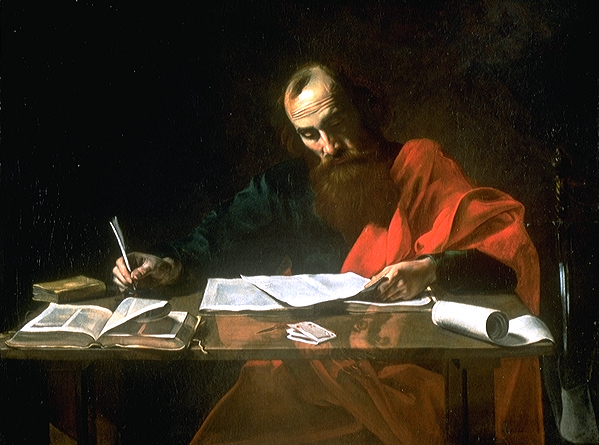
Paul's letters make up the majority of the New Testament and have been crucial in establishing the theology of the church. But all too often , we read the words of Paul without considering Paul himself. Behind each of these letters was an ordinary man who accomplished extraordinary things. Below is a look by Dr. Hooker of Oxford at how we should approach Paul, his letters, and his message.




If you would like to join our mailing list, please enter your email below
